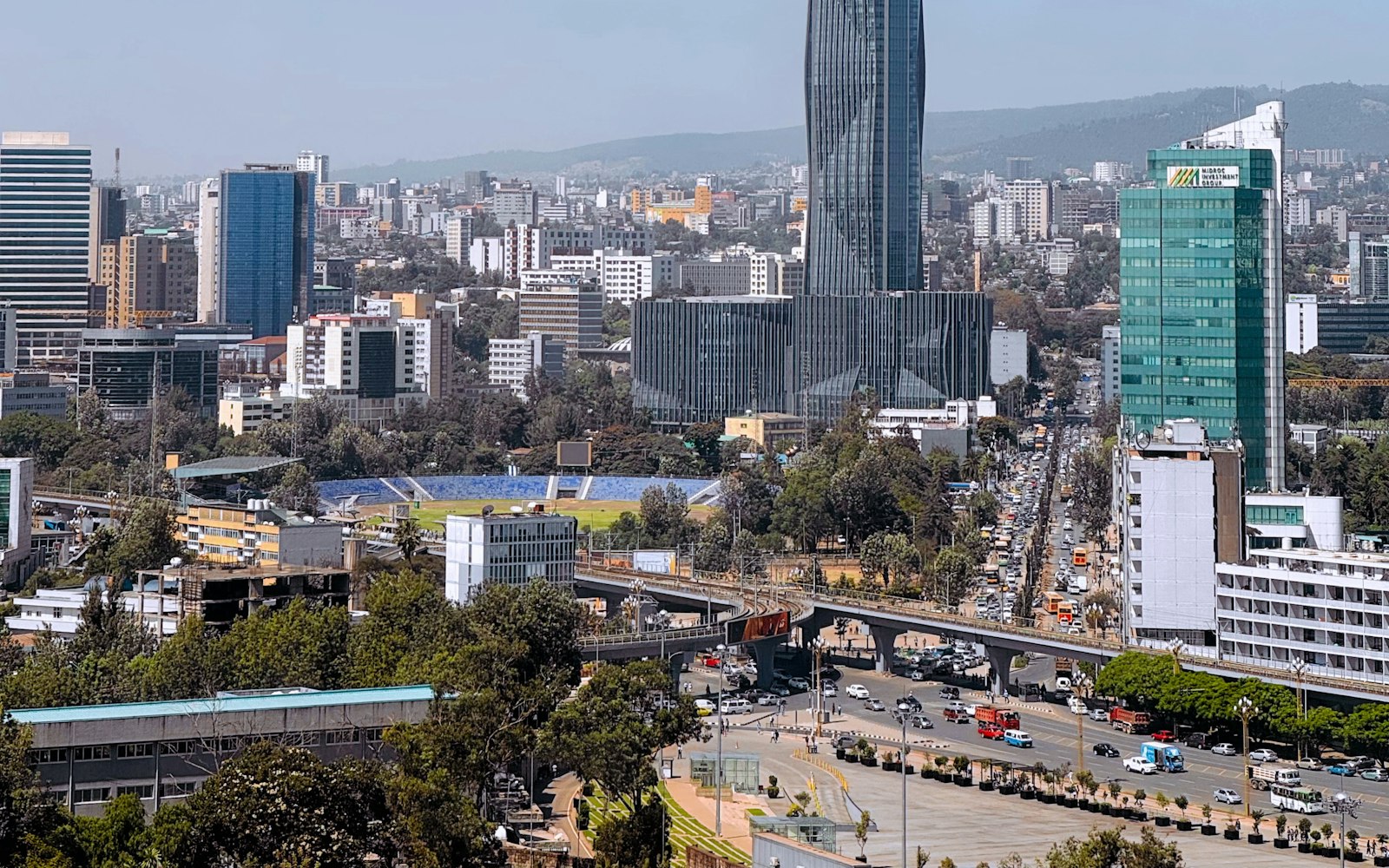
Ethiopia is going online fast. More people are using the internet each year, mobile money has become part of daily life, and customers increasingly look up a business on their phone before they call, visit or pay. Yet many Ethiopian businesses, schools, NGOs and government offices still have no website, or have one that is slow, outdated or hard to use on a phone.
In this first post on our blog, we look at where website development in Ethiopia stands today, what makes building for the Ethiopian market different, and what a good website should include in 2026.
Ethiopia’s digital landscape at a glance
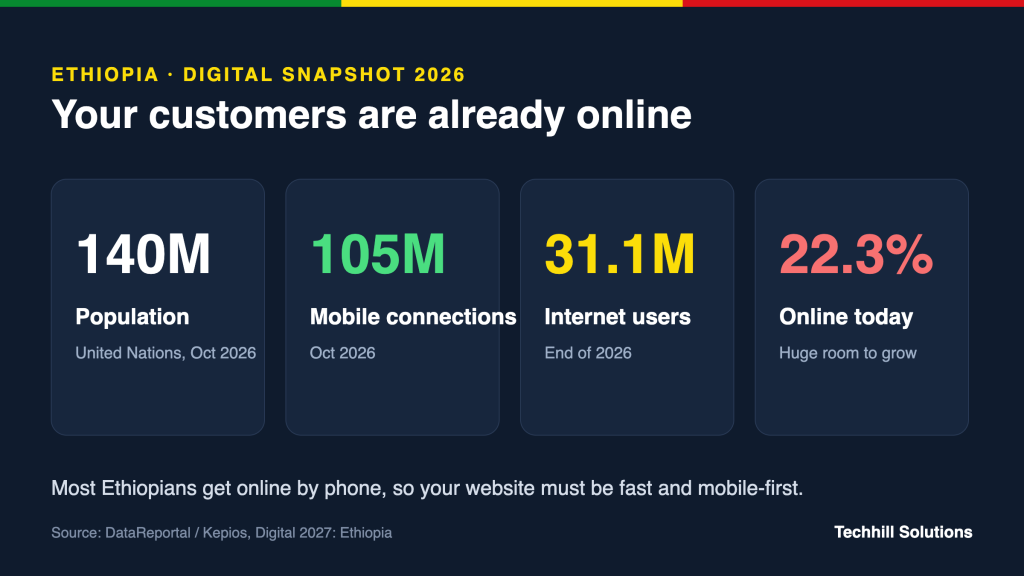
The numbers show a market that is growing quickly but still has plenty of room to grow:
- About 31 million internet users. DataReportal estimates there were 31.1 million people using the internet in Ethiopia at the end of 2026, around 22% of a population of roughly 140 million.
- More than 100 million mobile connections. For most Ethiopians, the phone is the main (and often the only) way to get online.
- Tens of millions of mobile money users. Services like telebirr and M-PESA have made digital payments familiar to a large share of the population.
- A national push to digitize. The government’s Digital Ethiopia strategy is moving the country from basic connectivity toward a digital economy, with more public services, payments and businesses moving online.
Put simply: the audience is already online, and it is growing every month. A business that is easy to find and use online today will be ahead of competitors that wait.
Why every Ethiopian business needs a website
Many businesses in Ethiopia rely on a Facebook page, a Telegram channel or a TikTok account. Social media is valuable, but it should not be your only home online. A website gives you:
- Credibility. International partners, investors, NGOs and diaspora customers expect to find a professional website before they do business with you.
- Control. You own your website and its content. A social media account can be restricted, lose reach after an algorithm change, or be hard to find in search.
- Visibility on Google. When someone searches for “hotel in Bahir Dar” or “accounting firm in Addis Ababa”, a well-built website is what shows up.
- Sales and bookings around the clock. Customers can see your products, prices and services, request a quote or book an appointment at any time.
- Access to the diaspora and international markets. Millions of Ethiopians abroad, plus tourists and foreign buyers, look for Ethiopian products and services online.
What makes website development in Ethiopia different
A website that works well in Europe or the US will not automatically work well in Ethiopia. Good Ethiopian web development takes local realities into account.
1. Mobile first, always

Most visitors will arrive on a smartphone, often a mid-range Android device. The site must be designed for small screens first, with large buttons, readable text and simple navigation, and only then adapted for desktop.
2. Speed and light pages
Connection speeds and data costs vary a lot across the country. Heavy images, autoplay videos and bloated themes drive visitors away and cost them money. Compressing images, keeping pages light, caching and using a content delivery network (CDN) make a big difference, especially outside Addis Ababa.
3. Amharic and multilingual content
Ethiopia is a multilingual country. Depending on your audience, your site may need Amharic, Afaan Oromo, Tigrinya or other languages alongside English. That means choosing fonts that display Ge’ez script correctly, planning layouts for different text lengths and setting up proper multilingual SEO.
4. Local payment integration
For e-commerce and online booking, international card payments alone are not enough. Ethiopian customers expect to pay with local options such as telebirr, M-PESA, CBE Birr or bank transfers through local payment gateways like Chapa or SantimPay. Diaspora customers may still need card or PayPal-style options. A good build supports both where it makes sense.
5. Reliable hosting and security
Choosing between local and international hosting affects speed, cost and reliability. Whatever you choose, your site needs an SSL certificate (https), regular backups, software updates and basic protection against hacking and spam.
6. Local SEO
Many customers search with a city or neighborhood in mind. Setting up a Google Business Profile, using local keywords, and making sure your address, phone number and map location are consistent everywhere helps you appear in local searches.
What a good website should include in 2026
Whether you run a small shop, a hotel, a school or a large company, a solid website usually includes:
- A clear homepage that says who you are and what you offer in a few seconds
- Service or product pages with prices or a clear way to request a quote
- An about page that builds trust (your story, team, licenses, partners)
- Easy contact options: phone, WhatsApp or Telegram, email, a contact form and a map
- A blog or news section to share updates and improve your search ranking
- Mobile-friendly design and fast loading times
- Analytics, so you know how many people visit and what they do
- A content management system (such as WordPress) so your team can update the site without a developer
How much does a website cost in Ethiopia?
Costs depend on what you need. A simple informational website for a small business costs far less than a custom e-commerce platform with payment integration, user accounts and multiple languages. When comparing quotes, look beyond the initial price and ask about:
- Hosting and domain renewal fees (including .et domains if you want one)
- Whether the site will be mobile-friendly and optimized for speed
- Who will own the website, domain and content
- Training so your team can update the site
- Ongoing support, security updates and backups
A cheap website that is slow, insecure or impossible to update often ends up costing more in the long run.
Common mistakes to avoid
- Building for desktop and forgetting mobile users
- Using huge, uncompressed images that slow down the site
- Leaving the site untouched for years, with old prices and broken links
- Registering the domain in a developer’s name instead of the business’s name
- Skipping basic SEO, so the site never shows up on Google
- No clear call to action, so visitors leave without contacting you
The road ahead
Ethiopia’s digital economy is still in its early chapters. As internet access spreads, digital payments grow and more services move online, a professional website will shift from a nice extra to a basic requirement for doing business. Organizations that invest now will build trust, reach and search visibility that are hard for late movers to catch up with.
Ready to build your website?

At Techhill Solutions, we help Ethiopian businesses and organizations plan, design and build websites that are fast, mobile-friendly and built for the local market. Whether you need your first website or want to improve the one you have, get in touch with our team and let’s talk about your project.
Stay tuned to our blog for more practical guides on web development, digital marketing and technology in Ethiopia.
Leave a Reply