Before a customer calls you, visits your office or signs a contract, they almost always do one thing first: they look you up online. In that moment, your website becomes your receptionist, your salesperson and your brand ambassador all at once. A strong website doesn’t just tell people you exist. It convinces them you are the right choice.
In this article, we look at why a professional website is one of the most powerful tools a company has for both growth and branding, and what separates a site that simply sits online from one that actively works for your business.
Your website is often the very first impression a customer has of your business.
1. Your Website Is Your Digital Headquarters
Social media pages, marketplace listings and directory profiles are useful, but you don’t own them. Algorithms change, platforms restrict reach and layouts are the same for everyone. Your website is the one place online where you control the whole experience: the message, the design, the content and the path a visitor takes.
That makes it the natural home base for all your marketing. Every ad, social post, email campaign and business card can point back to one trusted destination where people can learn more and take action.
2. Credibility and Trust Start Online
Today, a business without a website, or with an outdated one, raises questions. Is this company still operating? Are they established? Can I trust them with my money or my project? A modern, well-built website answers those questions before they are even asked.
Trust signals that a website can display include:
Client testimonials and case studies that show real results
Portfolios or galleries of completed work
Certifications, partnerships and awards
Clear contact details, a physical address and a professional email domain
Secure browsing (HTTPS) and fast, error-free pages
Trust built online carries over into real business relationships.
3. Branding: Telling Your Story Your Way
Your brand is more than a logo. It is the feeling people get when they interact with your company. A website is the best canvas for expressing that identity consistently, through colours, typography, imagery, tone of voice and the way information is organised.
Great websites start with careful planning of structure, layout and brand identity.
Consistency builds recognition
When your website, social profiles, brochures and email signatures share the same visual language, customers begin to recognise you instantly. Over time, that recognition turns into familiarity, and familiarity turns into preference.
Content that shows your expertise
A blog, resource centre or FAQ section lets you share knowledge and demonstrate authority in your industry. Helpful content positions your company as a trusted advisor rather than just another vendor, and it gives people a reason to return.
People don’t just buy products or services. They buy from brands they understand, recognise and trust. Your website is where that understanding begins.
4. A Growth Engine That Works 24/7
Your office may close at the end of the day, but your website never does. While your team is offline, your site can still be answering questions, collecting enquiries, booking appointments and even processing orders.
Lead generation: contact forms, quote requests and newsletter sign-ups turn visitors into prospects.
Online sales: e-commerce features let customers buy any time, from anywhere.
Reduced workload: FAQs, service pages and booking tools answer common questions automatically.
Wider reach: a website lets a local business serve customers in other cities and countries.
5. Be Found When Customers Are Searching
Every day, potential customers search Google for the exact products and services you offer. Search engine optimisation (SEO) helps your website appear in those results. With well-structured pages, relevant keywords, fast loading times and quality content, your site can attract steady, free traffic from people who are already looking for what you sell.
Unlike paid advertising, which stops the moment you stop paying, good SEO keeps delivering value over the long term.
6. Mobile-Friendly Means Customer-Friendly
Most people now browse on their phones. If your website is slow, hard to read or difficult to navigate on a small screen, visitors will leave and often go straight to a competitor. A responsive, mobile-first design ensures every customer gets a smooth experience, whatever device they use.
A mobile-friendly website makes it easy for customers to buy and enquire on the go.
7. Data-Driven Decisions
One of the biggest advantages of a website over traditional marketing is measurement. With tools such as Google Analytics and Search Console, you can see how many people visit, where they come from, which pages they read and what actions they take.
These insights help you understand what your customers want, which campaigns are working and where to invest next, so growth is based on evidence rather than guesswork.
Website analytics reveal how visitors find you and what they do on your site.
What Makes a Website Truly Effective?
Not every website delivers these results. The ones that do tend to share a few essentials:
A clear message that explains what you do and who you help within seconds
Professional, on-brand design that reflects the quality of your business
Fast loading speed and a mobile-responsive layout
Strong calls to action that guide visitors to call, enquire or buy
SEO foundations built in from day one
Regular updates, security maintenance and fresh content
Conclusion: Invest in Your Most Hard-Working Asset
A website is no longer a nice-to-have. It is the foundation of how modern companies build credibility, express their brand and grow. Done well, it becomes your most consistent salesperson, your most visible brand ambassador and your most valuable source of customer insight.
If your current website isn’t pulling its weight, or you don’t have one yet, now is the time to act. At Tech Hill Solutions, we design and build fast, secure, brand-focused websites that help businesses stand out and grow. Get in touch with our team today to talk about how your website can start working harder for you.
2026 was the year many Ethiopian businesses stopped asking whether they need to be online and started asking how to do it properly. Customers now search on Google before they visit a shop, pay with Telebirr or a mobile banking app instead of cash, and expect a quick reply on Telegram or WhatsApp. As we move into 2027, the gap between businesses that took digital seriously and those that did not will only grow wider.
In this article we look back at what 2026 taught us, the website development trends that will matter in 2027, and practical steps Ethiopian businesses can take to digitalize, plus how TechHill Solutions can help you get there.
Telebirr alone reported about 60.6 million registered customers and transactions worth roughly 4.19 trillion birr over its latest year. The National Bank of Ethiopia has also launched its National Digital Payments Strategy 2026–2030, which focuses on real usage, merchant acceptance, interoperability and consumer trust. The lesson is simple: if your customers cannot pay you digitally, on your website, through a payment link or by QR code, you are making it harder for them to buy from you.
2. Access is not the same as usage
Even with tens of millions of mobile money accounts, World Bank Findex data cited in the national payments strategy shows that only about one in five adults made or received a digital payment in a year. Many people have the tools but do not yet trust or understand them. Businesses that explain clearly, build simple and trustworthy online experiences, and support customers in Amharic and other local languages will win that next wave of users.
3. A Facebook page is not a business website
Social media is great for reach, but in 2026 many businesses learned the hard way that they do not own their pages. Accounts get hacked, algorithms change, and pages get restricted. A professional website on your own domain is the one digital asset you fully control, and it is what Google shows when people search for your service.
4. Speed and mobile experience decide everything
Most Ethiopian users browse on mobile phones, often on slower or expensive data. Heavy, slow websites lose visitors within seconds. In 2026, the businesses that saw real results were the ones with fast, light, mobile-first websites.
5. AI arrived in everyday business
From AI chat assistants to automatic content and translation tools, AI became part of normal work in 2026. Businesses that used it wisely saved time and served customers faster. Those that ignored it fell behind, and those that relied on it blindly published poor content that hurt their brand.
Website Development Trends to Watch in 2027
Mobile-first and lightweight design
In 2027, building for mobile first is no longer optional. Expect more focus on fast loading pages, optimized images, and designs that work well even on mid-range Android phones and 3G/4G connections.
Integrated local payments
Websites will increasingly connect directly to Telebirr, M-PESA, CBE Birr, Chapa, ArifPay and bank gateways. Online ordering, booking and invoicing with instant local payment will become the standard for retailers, hotels, schools, clinics and service providers.
AI-powered features
Smart chatbots that answer customer questions 24/7, product recommendations, automated FAQs and AI-assisted search will move from “nice to have” to expected. The key is using AI to support real customer service, not to replace it.
Multilingual websites
Serving customers in Amharic, Afaan Oromo, Tigrinya and English, alongside international visitors and the diaspora, will be a major competitive advantage. Multilingual content also helps you appear in more local search results.
Search visibility and AI search
People increasingly ask Google and AI assistants questions like “best hotel in Bahir Dar” or “software company in Addis Ababa”. Websites with clear, well-structured and genuinely helpful content, plus an updated Google Business Profile, will be the ones that get recommended.
Security and trust
With more payments and personal data moving online, customers will expect HTTPS, secure logins, reliable hosting, regular backups and clear privacy practices. Ethiopia’s digital ID system, Fayda, is also becoming a trusted identity layer for verification, which will shape how businesses onboard customers in the coming years.
Web apps and automation
More businesses will move beyond simple brochure websites to web applications: customer portals, booking systems, inventory dashboards and internal tools that automate daily operations and reduce paperwork.
Why Ethiopian Businesses Must Focus on Digitalization Now
Ethiopia’s national direction is clear. The Digital Ethiopia 2030 strategy builds on Digital Ethiopia 2025 and shifts the focus from basic connectivity to a digitally innovative economy, built on digital public infrastructure such as Fayda digital ID, interoperable payments and e-services. When government services, banks and customers all move online, businesses that stay offline will become harder to find and harder to buy from.
Digitalization helps you:
Reach more customers across Ethiopia and in the diaspora, not just people who walk past your shop.
Sell and get paid 24/7 with online orders and digital payments.
Cut costs by automating bookings, invoicing, inventory and reporting.
Build trust with a professional online presence and clear information.
Make better decisions using real data about your customers and sales.
A Practical Digital Checklist for 2027
Get a professional website on your own domain, fast and mobile-friendly.
Claim and update your Google Business Profile with correct location, hours, phone number and photos.
Accept digital payments on your website and in store through Telebirr, M-PESA, bank apps or a payment gateway.
Connect your channels so your website, Telegram, WhatsApp, Facebook and TikTok all point customers to the same place.
Publish helpful content that answers your customers’ real questions, in the languages they speak.
Automate one process this year, such as bookings, orders, invoicing or stock tracking.
Protect your business with secure hosting, SSL, backups and staff awareness about scams and phishing.
Train your team to use digital tools confidently, including AI, safely and responsibly.
How TechHill Solutions Helps Ethiopian Businesses Go Digital
At TechHill Solutions, we help Ethiopian businesses turn digital plans into working systems that bring real results. Whether you are a small shop in Addis Ababa, a growing company, an NGO or a school, we can help you:
Design and build modern websites that are fast, mobile-first, secure and SEO-ready.
Develop e-commerce stores with local payment integrations such as Telebirr, M-PESA and Chapa.
Build custom web and mobile applications, including booking systems, portals, dashboards and internal tools.
Add AI and automation, from customer chatbots to workflow automation that saves time.
Improve your visibility with search engine optimization and Google Business setup.
Provide hosting, maintenance and support so your website stays secure, updated and online.
We understand the local market: the payment systems, the languages, the connectivity realities and the way Ethiopian customers buy. That is why we build solutions that work here, not just templates copied from elsewhere.
2026 showed that Ethiopian customers are ready for digital: they pay digitally, search online and expect fast, modern service. 2027 will reward the businesses that act on that lesson. Start with a strong website, accept digital payments, automate where you can, and keep learning.
Ready to grow your business online in 2027? Contact TechHill Solutions today for a free consultation, and let’s build your digital future together.
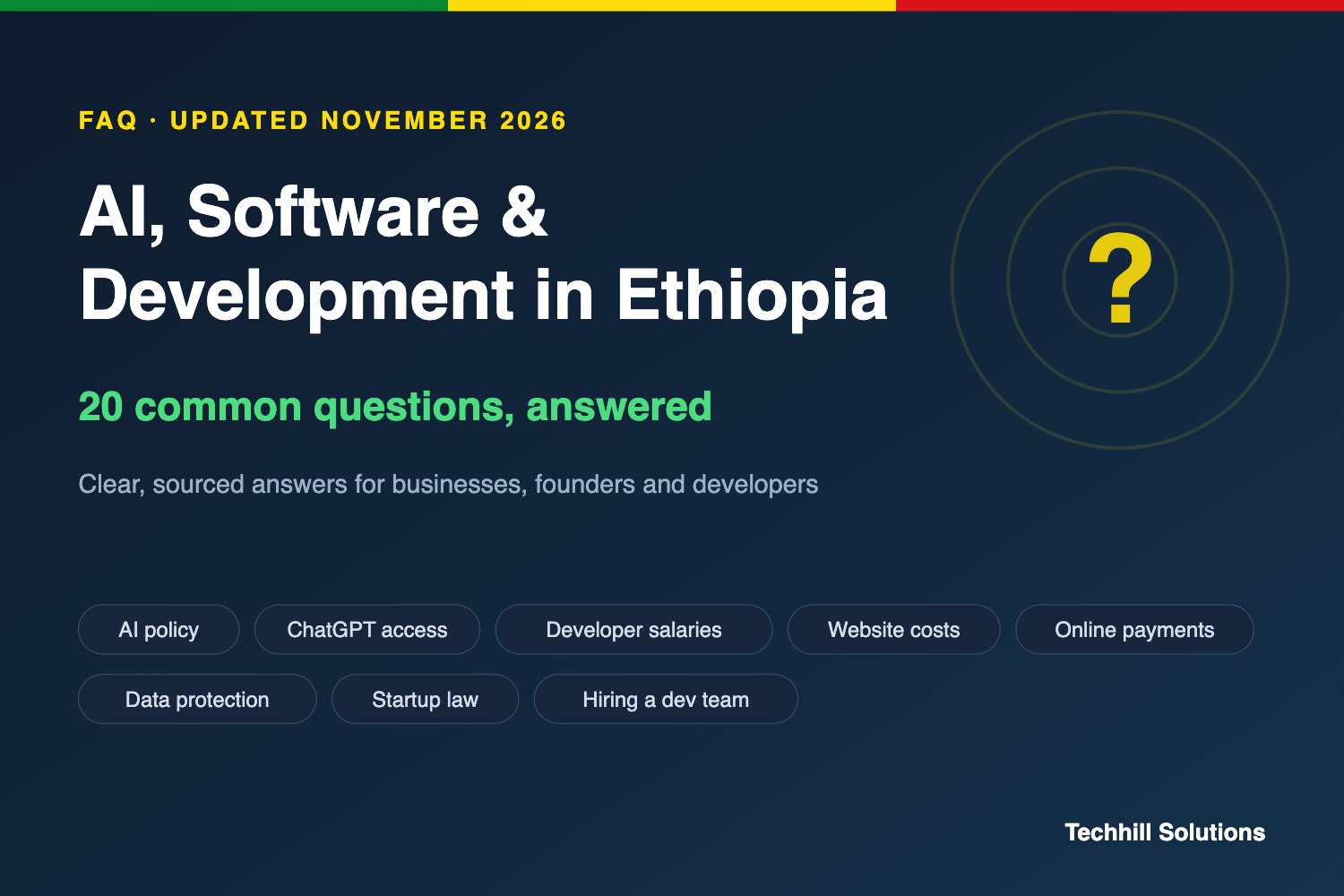
Every week, business owners, founders, students and developers ask us the same questions about technology in Ethiopia. Is ChatGPT available here? What does the national AI policy say? How much does a website cost? Which laws apply to online businesses? This guide answers the 20 most common questions in plain language, with links to the official and trusted sources behind each answer.
Key takeaways
AI is officially supported: Ethiopia has a National AI Policy (June 2024) coordinated by the Ethiopian Artificial Intelligence Institute, and ChatGPT is available in the country.
Talent is growing: Ethiopia has a young, fast-growing developer workforce working for local firms and international clients.
Mobile money powers online payments: websites in Ethiopia typically accept telebirr, CBE Birr, M-PESA and local gateways like Chapa and SantimPay.
Data protection is now law: Proclamation No. 1321/2024 applies to any organization handling personal data in Ethiopia.
Startups have a legal framework: the Startup Proclamation No. 1396/2025 introduces designation, incentives and a startup fund.
Yes. Ethiopia is on OpenAI’s official list of supported countries, so people in Ethiopia can sign up for ChatGPT and the OpenAI API without a VPN. Google’s AI chatbot (now Gemini) has also been available in Ethiopia since 2023.
This is a big change from early 2023, when ChatGPT was not accessible in Ethiopia and many users relied on VPNs or locally built tools based on older models. Today, Ethiopian businesses can use these AI tools directly and build them into websites and apps through their APIs.
Does Ethiopia have a national AI policy?
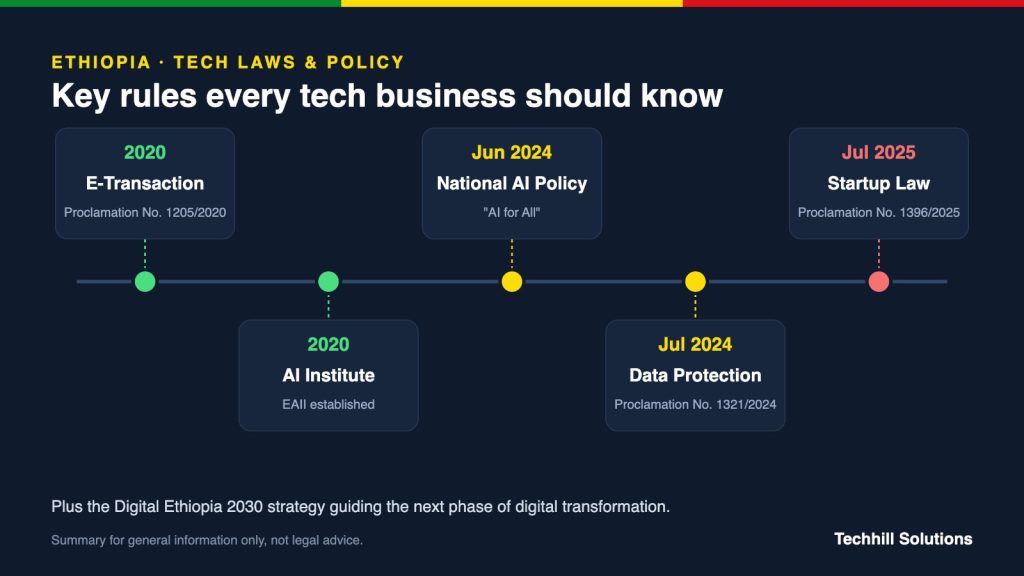
Yes. Ethiopia’s National Artificial Intelligence Policy was approved by the Council of Ministers on 27 June 2024. It guides how public and private organizations develop and use AI, sets risk-management expectations for critical sectors, and names the Ethiopian Artificial Intelligence Institute (EAII) as the coordinating body. Its motto is “AI for All.”
The policy was developed through a multi-stakeholder process led by the EAII and the Ministry of Innovation and Technology. It encourages collaboration between government, universities, the private sector, the Ethiopian diaspora and international partners.
What is the Ethiopian Artificial Intelligence Institute (EAII)?
The EAII is the federal agency responsible for AI in Ethiopia. Established in 2020 and accountable to the Prime Minister, it carries out AI research and training, helps shape national AI policy, and can certify AI products and services for use in the country. Its 2025/26 budget was 1.13 billion Birr, a 42% increase on the previous year.
In February 2026, the EAII opened an AI University Innovation Pod (UniPod) with UNDP and Addis Ababa University, a hub for developing AI solutions with national and pan-African impact.
How are Ethiopian businesses and institutions using AI?
The most common uses are customer-service chatbots, document and data processing, fraud and risk detection, and tools for agriculture, education and finance. For example, in January 2026 the EAII and Ethiopia’s Financial Intelligence Service agreed to build an AI system to help detect money laundering and illicit financial flows.
For small and medium businesses, practical starting points include:
An Amharic and English chatbot on your website or Telegram channel that answers common questions
Automatically sorting and replying to customer messages and emails
Summarizing reports, contracts and meeting notes
Drafting marketing content and product descriptions
Smarter search and recommendations on e-commerce websites
Can AI tools understand Amharic and other Ethiopian languages?
Increasingly, yes, but quality still lags behind English. Leading AI models can read and write Amharic well enough for many everyday tasks, and the EAII is working on natural language processing for Ethiopian languages. For customer-facing tools in Amharic, Afaan Oromo or Tigrinya, always test with native speakers before launch.
What are the biggest challenges for AI in Ethiopia?
The two most cited challenges are a shortage of high-quality local data and a lack of skilled AI professionals. The EAII’s Director General has described data as the “fuel” for AI systems. Internet access, affordability and computing infrastructure also limit how quickly AI spreads beyond major cities.
Salaries vary widely by experience and employer. WageIndicator puts most software developers between about ETB 10,600 and ETB 34,500 per month, while higher-paying private and outsourcing firms report roughly ETB 30,000–70,000 for juniors, ETB 80,000–150,000 for mid-level and ETB 150,000–350,000 for senior developers. Developers working remotely for foreign companies often earn more.
Pay depends heavily on the employer (government, local private company, international NGO, outsourcing firm or remote foreign employer), specialization and English communication skills.
Is Ethiopia a good place to outsource software development?
For many companies, yes. Ethiopia offers a large, young pool of tech graduates, competitive costs, and a time zone (UTC+3) that overlaps well with Europe, the Middle East and East Africa. The main trade-offs are uneven internet speeds outside major cities and foreign-currency payment friction, so choose a partner with reliable infrastructure and clear contracts.
How do Ethiopian developers and freelancers get paid by foreign clients?
Usually through international bank transfers to an Ethiopian bank, payouts from freelance platforms, or licensed money-transfer and payment services. PayPal is not a full option: accounts registered in Ethiopia can send payments but cannot receive or withdraw funds. Be wary of any “client” who insists on paying through gift cards, crypto or a personal mobile-money line.
Which programming skills are most in demand in Ethiopia?
From what we see in the market, the most requested skills are JavaScript and TypeScript (React, Next.js, Node.js), PHP and WordPress, Python (Django, FastAPI, data and AI work), Flutter for mobile apps, and Java or .NET for banks and enterprise systems. Payment integration, cloud hosting and AI API skills are increasingly valuable.
Building websites and apps in Ethiopia
How much does it cost to build a website in Ethiopia?
It depends on scope. A simple informational website for a small business costs far less than an e-commerce store or a custom web application with user accounts, payments and multiple languages. When comparing quotes, check what is included: hosting, domain, mobile-friendly design, SEO setup, training, security updates and ongoing support, and ask for a fixed-scope written quote.
As a rough guide, a simple business website takes 2–4 weeks, a larger company website 4–8 weeks, and an e-commerce site or mobile app 2–6 months. The biggest factor is usually how quickly content, photos and feedback are provided, not the coding itself.
How can my website accept online payments in Ethiopia?
Most Ethiopian websites accept payments through mobile money and local payment gateways such as telebirr, CBE Birr, M-PESA, Chapa and SantimPay. For international card payments, some Ethiopian banks offer card payment gateways. Online sellers are expected to work with payment operators licensed by the National Bank of Ethiopia.
If you sell to the diaspora or international customers, plan for both local mobile money and card payments from the start, so checkout works for everyone.
Should I build a website or a mobile app first?
For most businesses, start with a fast, mobile-friendly website. It works on every phone without a download, can be found on Google, and costs less to build and maintain. Build a native app later if customers will use it often, for example for ordering, banking, booking or loyalty programs.
Should I host my website in Ethiopia or abroad?
It depends on your audience and the data you collect. International hosting is often cheaper and offers more features, while local hosting can be faster for visitors in Ethiopia. If your site collects personal data from people in Ethiopia, the Personal Data Protection Proclamation restricts transferring personal data abroad, so get legal advice and consider local hosting for sensitive data.
Tech laws and regulations in Ethiopia
Key Ethiopian tech laws and policies at a glance. General information, not legal advice.
Does Ethiopia have a data protection law?
Yes. The Personal Data Protection Proclamation No. 1321/2024 was adopted by Parliament on 4 April 2024 and entered into force on 24 July 2024. It applies to public and private organizations that handle personal data in Ethiopia and is enforced by the Ethiopian Communications Authority (ECA). Key duties include obtaining consent, keeping data secure, reporting breaches and limiting cross-border transfers.
For a typical business website, practical first steps are:
Publish a clear privacy policy
Ask for consent on contact forms, sign-ups and non-essential cookies
Collect only the data you actually need
Use HTTPS, strong passwords and limited admin access
Know where your hosting provider stores your data
This is general information, not legal advice. Speak to a qualified Ethiopian lawyer about your specific situation.
What law governs e-commerce and online transactions in Ethiopia?
The Electronic Transaction Proclamation No. 1205/2020 gives legal recognition to electronic transactions, records and signatures, and provides the legal basis for e-commerce and e-government services. It also includes provisions on consumer protection, digital payments and electronic receipts.
Is there a startup law in Ethiopia?
Yes. The Startup Proclamation No. 1396/2025, approved by Parliament in July 2025, is Ethiopia’s first legal framework for startups. It creates a startup designation system, a Startup Ethiopia Council and a startup innovation fund, offers incentives, and exempts foreign startups from minimum investment capital requirements. Implementing rules are still being rolled out.
Founders still report licensing delays across different levels of government, so allow extra time for registration and permits.
Working with a development company
How do I choose a reliable software or web development company in Ethiopia?
Look at their portfolio of live projects, speak to past clients, and ask who will actually do the work. A good partner gives a clear written scope, timeline and price, explains hosting and maintenance costs, follows data protection rules, and registers your domain and code in your name.
Who owns my website, domain and source code?
You should. Make sure the contract states that the domain is registered in your business’s name and that you own the website content and source code once it is paid for. Also ask for admin access, hosting logins and backups, so you are never locked in to one developer.
Final thoughts
Ethiopia’s tech sector is moving fast. A national AI policy, new data protection and startup laws, widespread mobile money and a growing pool of developers are creating real opportunities for businesses that go digital now. The key is to build on the right foundation: a fast, mobile-friendly website, secure handling of customer data, and partners who understand the local market.
Have a question we didn’t answer?
At Techhill Solutions, we design and build websites, web applications and AI-powered tools for businesses and organizations in Ethiopia. If you are planning a project or have a question about technology in Ethiopia, get in touch with our team. We are happy to help.
Ethiopia is going online fast. More people are using the internet each year, mobile money has become part of daily life, and customers increasingly look up a business on their phone before they call, visit or pay. Yet many Ethiopian businesses, schools, NGOs and government offices still have no website, or have one that is slow, outdated or hard to use on a phone.
In this first post on our blog, we look at where website development in Ethiopia stands today, what makes building for the Ethiopian market different, and what a good website should include in 2026.
Ethiopia’s digital landscape at a glance
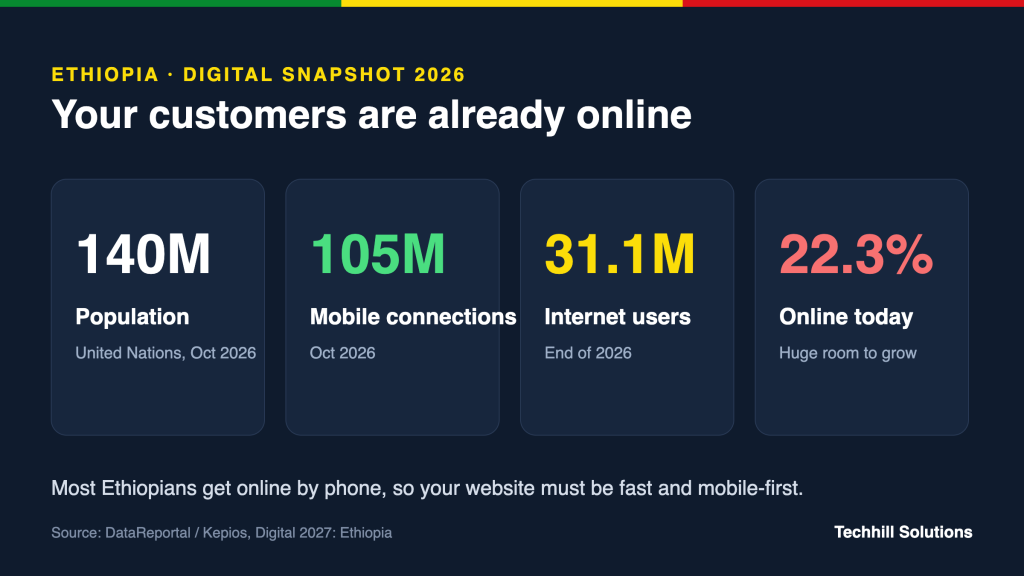
Ethiopia’s digital landscape in numbers. Source: DataReportal / Kepios, Digital 2027: Ethiopia
The numbers show a market that is growing quickly but still has plenty of room to grow:
About 31 million internet users. DataReportal estimates there were 31.1 million people using the internet in Ethiopia at the end of 2026, around 22% of a population of roughly 140 million.
More than 100 million mobile connections. For most Ethiopians, the phone is the main (and often the only) way to get online.
Tens of millions of mobile money users. Services like telebirr and M-PESA have made digital payments familiar to a large share of the population.
A national push to digitize. The government’s Digital Ethiopia strategy is moving the country from basic connectivity toward a digital economy, with more public services, payments and businesses moving online.
Put simply: the audience is already online, and it is growing every month. A business that is easy to find and use online today will be ahead of competitors that wait.
Why every Ethiopian business needs a website
Small businesses can reach far more customers with a simple website. Photo: Msganaw Wogaso on Unsplash
Many businesses in Ethiopia rely on a Facebook page, a Telegram channel or a TikTok account. Social media is valuable, but it should not be your only home online. A website gives you:
Credibility. International partners, investors, NGOs and diaspora customers expect to find a professional website before they do business with you.
Control. You own your website and its content. A social media account can be restricted, lose reach after an algorithm change, or be hard to find in search.
Visibility on Google. When someone searches for “hotel in Bahir Dar” or “accounting firm in Addis Ababa”, a well-built website is what shows up.
Sales and bookings around the clock. Customers can see your products, prices and services, request a quote or book an appointment at any time.
Access to the diaspora and international markets. Millions of Ethiopians abroad, plus tourists and foreign buyers, look for Ethiopian products and services online.
What makes website development in Ethiopia different
A website that works well in Europe or the US will not automatically work well in Ethiopia. Good Ethiopian web development takes local realities into account.
1. Mobile first, always
For most Ethiopians, the phone is the internet. Photo: Emmanuel Ikwuegbu on Unsplash
Most visitors will arrive on a smartphone, often a mid-range Android device. The site must be designed for small screens first, with large buttons, readable text and simple navigation, and only then adapted for desktop.
2. Speed and light pages
Connection speeds and data costs vary a lot across the country. Heavy images, autoplay videos and bloated themes drive visitors away and cost them money. Compressing images, keeping pages light, caching and using a content delivery network (CDN) make a big difference, especially outside Addis Ababa.
3. Amharic and multilingual content
Ethiopia is a multilingual country. Depending on your audience, your site may need Amharic, Afaan Oromo, Tigrinya or other languages alongside English. That means choosing fonts that display Ge’ez script correctly, planning layouts for different text lengths and setting up proper multilingual SEO.
4. Local payment integration
For e-commerce and online booking, international card payments alone are not enough. Ethiopian customers expect to pay with local options such as telebirr, M-PESA, CBE Birr or bank transfers through local payment gateways like Chapa or SantimPay. Diaspora customers may still need card or PayPal-style options. A good build supports both where it makes sense.
5. Reliable hosting and security
Choosing between local and international hosting affects speed, cost and reliability. Whatever you choose, your site needs an SSL certificate (https), regular backups, software updates and basic protection against hacking and spam.
6. Local SEO
Many customers search with a city or neighborhood in mind. Setting up a Google Business Profile, using local keywords, and making sure your address, phone number and map location are consistent everywhere helps you appear in local searches.
What a good website should include in 2026
Whether you run a small shop, a hotel, a school or a large company, a solid website usually includes:
A clear homepage that says who you are and what you offer in a few seconds
Service or product pages with prices or a clear way to request a quote
An about page that builds trust (your story, team, licenses, partners)
Easy contact options: phone, WhatsApp or Telegram, email, a contact form and a map
A blog or news section to share updates and improve your search ranking
Mobile-friendly design and fast loading times
Analytics, so you know how many people visit and what they do
A content management system (such as WordPress) so your team can update the site without a developer
How much does a website cost in Ethiopia?
Costs depend on what you need. A simple informational website for a small business costs far less than a custom e-commerce platform with payment integration, user accounts and multiple languages. When comparing quotes, look beyond the initial price and ask about:
Hosting and domain renewal fees (including .et domains if you want one)
Whether the site will be mobile-friendly and optimized for speed
Who will own the website, domain and content
Training so your team can update the site
Ongoing support, security updates and backups
A cheap website that is slow, insecure or impossible to update often ends up costing more in the long run.
Common mistakes to avoid
Building for desktop and forgetting mobile users
Using huge, uncompressed images that slow down the site
Leaving the site untouched for years, with old prices and broken links
Registering the domain in a developer’s name instead of the business’s name
Skipping basic SEO, so the site never shows up on Google
No clear call to action, so visitors leave without contacting you
The road ahead
Ethiopia’s digital economy is still in its early chapters. As internet access spreads, digital payments grow and more services move online, a professional website will shift from a nice extra to a basic requirement for doing business. Organizations that invest now will build trust, reach and search visibility that are hard for late movers to catch up with.
At Techhill Solutions, we help Ethiopian businesses and organizations plan, design and build websites that are fast, mobile-friendly and built for the local market. Whether you need your first website or want to improve the one you have, get in touch with our team and let’s talk about your project.
Stay tuned to our blog for more practical guides on web development, digital marketing and technology in Ethiopia.