Last updated: 19 November 2026
Every week, business owners, founders, students and developers ask us the same questions about technology in Ethiopia. Is ChatGPT available here? What does the national AI policy say? How much does a website cost? Which laws apply to online businesses? This guide answers the 20 most common questions in plain language, with links to the official and trusted sources behind each answer.
Key takeaways
- AI is officially supported: Ethiopia has a National AI Policy (June 2024) coordinated by the Ethiopian Artificial Intelligence Institute, and ChatGPT is available in the country.
- Talent is growing: Ethiopia has a young, fast-growing developer workforce working for local firms and international clients.
- Mobile money powers online payments: websites in Ethiopia typically accept telebirr, CBE Birr, M-PESA and local gateways like Chapa and SantimPay.
- Data protection is now law: Proclamation No. 1321/2024 applies to any organization handling personal data in Ethiopia.
- Startups have a legal framework: the Startup Proclamation No. 1396/2025 introduces designation, incentives and a startup fund.
Contents
- Artificial intelligence (AI) in Ethiopia
- Software development and tech careers
- Building websites and apps in Ethiopia
- Tech laws and regulations in Ethiopia
- Working with a development company
Artificial intelligence (AI) in Ethiopia
Is ChatGPT available in Ethiopia?
Yes. Ethiopia is on OpenAI’s official list of supported countries, so people in Ethiopia can sign up for ChatGPT and the OpenAI API without a VPN. Google’s AI chatbot (now Gemini) has also been available in Ethiopia since 2023.
This is a big change from early 2023, when ChatGPT was not accessible in Ethiopia and many users relied on VPNs or locally built tools based on older models. Today, Ethiopian businesses can use these AI tools directly and build them into websites and apps through their APIs.
Does Ethiopia have a national AI policy?
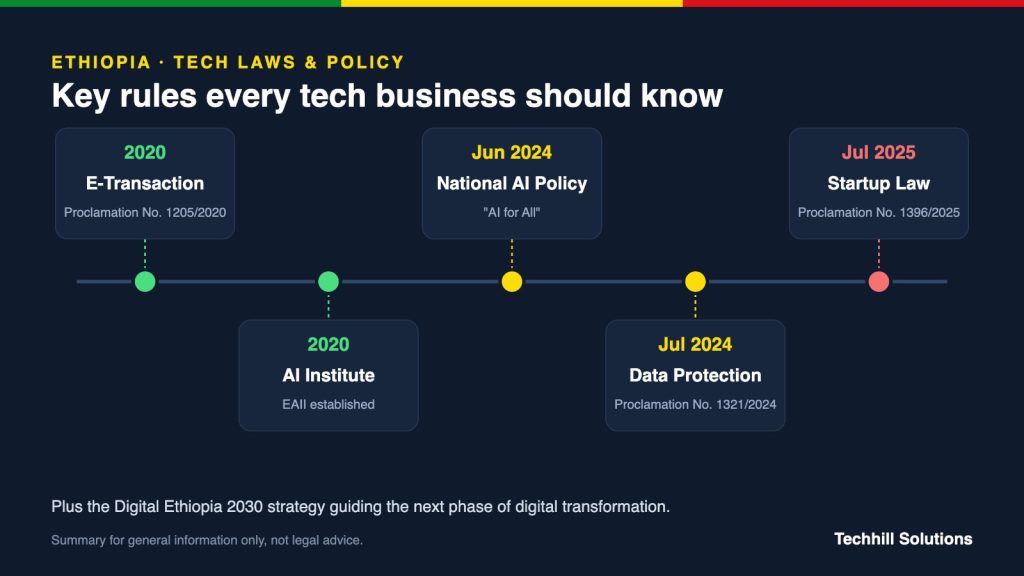
Yes. Ethiopia’s National Artificial Intelligence Policy was approved by the Council of Ministers on 27 June 2024. It guides how public and private organizations develop and use AI, sets risk-management expectations for critical sectors, and names the Ethiopian Artificial Intelligence Institute (EAII) as the coordinating body. Its motto is “AI for All.”
The policy was developed through a multi-stakeholder process led by the EAII and the Ministry of Innovation and Technology. It encourages collaboration between government, universities, the private sector, the Ethiopian diaspora and international partners.
What is the Ethiopian Artificial Intelligence Institute (EAII)?
The EAII is the federal agency responsible for AI in Ethiopia. Established in 2020 and accountable to the Prime Minister, it carries out AI research and training, helps shape national AI policy, and can certify AI products and services for use in the country. Its 2025/26 budget was 1.13 billion Birr, a 42% increase on the previous year.
In February 2026, the EAII opened an AI University Innovation Pod (UniPod) with UNDP and Addis Ababa University, a hub for developing AI solutions with national and pan-African impact.
How are Ethiopian businesses and institutions using AI?
The most common uses are customer-service chatbots, document and data processing, fraud and risk detection, and tools for agriculture, education and finance. For example, in January 2026 the EAII and Ethiopia’s Financial Intelligence Service agreed to build an AI system to help detect money laundering and illicit financial flows.
For small and medium businesses, practical starting points include:
- An Amharic and English chatbot on your website or Telegram channel that answers common questions
- Automatically sorting and replying to customer messages and emails
- Summarizing reports, contracts and meeting notes
- Drafting marketing content and product descriptions
- Smarter search and recommendations on e-commerce websites
Can AI tools understand Amharic and other Ethiopian languages?
Increasingly, yes, but quality still lags behind English. Leading AI models can read and write Amharic well enough for many everyday tasks, and the EAII is working on natural language processing for Ethiopian languages. For customer-facing tools in Amharic, Afaan Oromo or Tigrinya, always test with native speakers before launch.
What are the biggest challenges for AI in Ethiopia?
The two most cited challenges are a shortage of high-quality local data and a lack of skilled AI professionals. The EAII’s Director General has described data as the “fuel” for AI systems. Internet access, affordability and computing infrastructure also limit how quickly AI spreads beyond major cities.
Software development and tech careers

How much do software developers earn in Ethiopia?
Salaries vary widely by experience and employer. WageIndicator puts most software developers between about ETB 10,600 and ETB 34,500 per month, while higher-paying private and outsourcing firms report roughly ETB 30,000–70,000 for juniors, ETB 80,000–150,000 for mid-level and ETB 150,000–350,000 for senior developers. Developers working remotely for foreign companies often earn more.
Pay depends heavily on the employer (government, local private company, international NGO, outsourcing firm or remote foreign employer), specialization and English communication skills.
Is Ethiopia a good place to outsource software development?
For many companies, yes. Ethiopia offers a large, young pool of tech graduates, competitive costs, and a time zone (UTC+3) that overlaps well with Europe, the Middle East and East Africa. The main trade-offs are uneven internet speeds outside major cities and foreign-currency payment friction, so choose a partner with reliable infrastructure and clear contracts.
How do Ethiopian developers and freelancers get paid by foreign clients?
Usually through international bank transfers to an Ethiopian bank, payouts from freelance platforms, or licensed money-transfer and payment services. PayPal is not a full option: accounts registered in Ethiopia can send payments but cannot receive or withdraw funds. Be wary of any “client” who insists on paying through gift cards, crypto or a personal mobile-money line.
Which programming skills are most in demand in Ethiopia?
From what we see in the market, the most requested skills are JavaScript and TypeScript (React, Next.js, Node.js), PHP and WordPress, Python (Django, FastAPI, data and AI work), Flutter for mobile apps, and Java or .NET for banks and enterprise systems. Payment integration, cloud hosting and AI API skills are increasingly valuable.
Building websites and apps in Ethiopia
How much does it cost to build a website in Ethiopia?
It depends on scope. A simple informational website for a small business costs far less than an e-commerce store or a custom web application with user accounts, payments and multiple languages. When comparing quotes, check what is included: hosting, domain, mobile-friendly design, SEO setup, training, security updates and ongoing support, and ask for a fixed-scope written quote.
For a deeper look at what a good Ethiopian website needs, read our guide: Website Development in Ethiopia: A Complete Guide for Businesses in 2026.
How long does it take to build a website or app?
As a rough guide, a simple business website takes 2–4 weeks, a larger company website 4–8 weeks, and an e-commerce site or mobile app 2–6 months. The biggest factor is usually how quickly content, photos and feedback are provided, not the coding itself.
How can my website accept online payments in Ethiopia?
Most Ethiopian websites accept payments through mobile money and local payment gateways such as telebirr, CBE Birr, M-PESA, Chapa and SantimPay. For international card payments, some Ethiopian banks offer card payment gateways. Online sellers are expected to work with payment operators licensed by the National Bank of Ethiopia.
If you sell to the diaspora or international customers, plan for both local mobile money and card payments from the start, so checkout works for everyone.
Should I build a website or a mobile app first?
For most businesses, start with a fast, mobile-friendly website. It works on every phone without a download, can be found on Google, and costs less to build and maintain. Build a native app later if customers will use it often, for example for ordering, banking, booking or loyalty programs.
Should I host my website in Ethiopia or abroad?
It depends on your audience and the data you collect. International hosting is often cheaper and offers more features, while local hosting can be faster for visitors in Ethiopia. If your site collects personal data from people in Ethiopia, the Personal Data Protection Proclamation restricts transferring personal data abroad, so get legal advice and consider local hosting for sensitive data.
Tech laws and regulations in Ethiopia
Does Ethiopia have a data protection law?
Yes. The Personal Data Protection Proclamation No. 1321/2024 was adopted by Parliament on 4 April 2024 and entered into force on 24 July 2024. It applies to public and private organizations that handle personal data in Ethiopia and is enforced by the Ethiopian Communications Authority (ECA). Key duties include obtaining consent, keeping data secure, reporting breaches and limiting cross-border transfers.
For a typical business website, practical first steps are:
- Publish a clear privacy policy
- Ask for consent on contact forms, sign-ups and non-essential cookies
- Collect only the data you actually need
- Use HTTPS, strong passwords and limited admin access
- Know where your hosting provider stores your data
This is general information, not legal advice. Speak to a qualified Ethiopian lawyer about your specific situation.
What law governs e-commerce and online transactions in Ethiopia?
The Electronic Transaction Proclamation No. 1205/2020 gives legal recognition to electronic transactions, records and signatures, and provides the legal basis for e-commerce and e-government services. It also includes provisions on consumer protection, digital payments and electronic receipts.
Is there a startup law in Ethiopia?
Yes. The Startup Proclamation No. 1396/2025, approved by Parliament in July 2025, is Ethiopia’s first legal framework for startups. It creates a startup designation system, a Startup Ethiopia Council and a startup innovation fund, offers incentives, and exempts foreign startups from minimum investment capital requirements. Implementing rules are still being rolled out.
Founders still report licensing delays across different levels of government, so allow extra time for registration and permits.
Working with a development company
How do I choose a reliable software or web development company in Ethiopia?
Look at their portfolio of live projects, speak to past clients, and ask who will actually do the work. A good partner gives a clear written scope, timeline and price, explains hosting and maintenance costs, follows data protection rules, and registers your domain and code in your name.
Who owns my website, domain and source code?
You should. Make sure the contract states that the domain is registered in your business’s name and that you own the website content and source code once it is paid for. Also ask for admin access, hosting logins and backups, so you are never locked in to one developer.
Final thoughts
Ethiopia’s tech sector is moving fast. A national AI policy, new data protection and startup laws, widespread mobile money and a growing pool of developers are creating real opportunities for businesses that go digital now. The key is to build on the right foundation: a fast, mobile-friendly website, secure handling of customer data, and partners who understand the local market.
Have a question we didn’t answer?
At Techhill Solutions, we design and build websites, web applications and AI-powered tools for businesses and organizations in Ethiopia. If you are planning a project or have a question about technology in Ethiopia, get in touch with our team. We are happy to help.
Sources
- OpenAI: ChatGPT and OpenAI API supported countries and territories
- OECD.AI: Ethiopia National Artificial Intelligence Policy
- Regulations.AI: Ethiopia National AI Policy (2024)
- Shega: Ethiopia doubles down on AI with 42% budget boost
- UNDP: Ethiopia launches an AI UniPod
- Dawan Africa: Ethiopia taps AI to fight financial crimes
- Capital Ethiopia: AI sector faces data and skills challenges
- WageIndicator: Software developer salaries in Ethiopia
- Africarrieres: Salary guide by profession, Ethiopia
- OneSafe: Does PayPal work in Ethiopia?
- Digital Policy Alert: Personal Data Protection Proclamation No. 1321/2024
- Mondaq: Ethiopian Personal Data Protection Law business compliance guide
- Shega Digital Finance: Electronic Transaction Proclamation No. 1205/2020
- U.S. International Trade Administration: Ethiopia digital economy
- Mondaq: Ethiopia’s new Startup Proclamation No. 1396/2025
- The Reporter: Foreign startups exempted from investment capital requirements
- Capital Ethiopia: Startups encounter licensing bottlenecks