cms

Category: AI & Software

Answers and insights on artificial intelligence and software development in Ethiopia.

  • Computer Science vs. Software Engineering in the Age of AI: Which Should You Study?

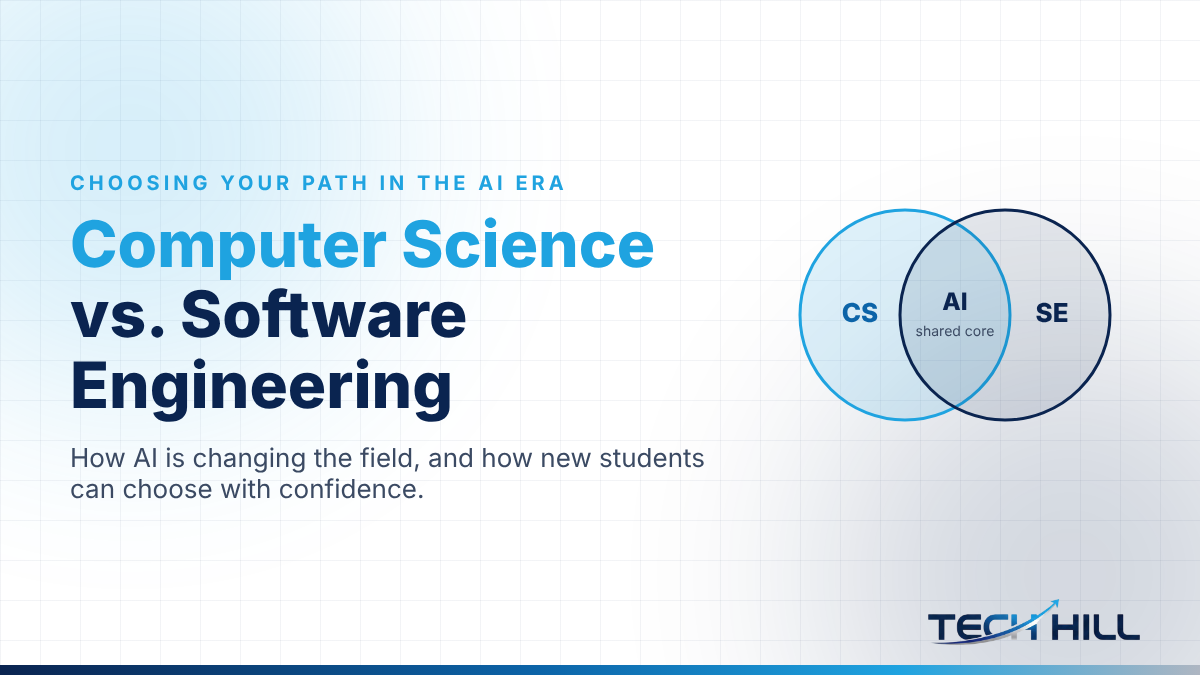
    Computer Science vs. Software Engineering in the Age of AI: Which Should You Study?

    Last updated: 20 November 2026

    Picture a student sitting with a university application, cursor hovering between two boxes: Computer Science and Software Engineering. Both promise a career in tech. Both teach programming. Both lead to jobs with “software” in the title. So which one is right?

    A few years ago, that question was mostly about preference. Today it carries more weight. AI tools can now write, test and explain code, and many students quietly wonder whether either degree will still matter by the time they graduate. This guide explains how AI is changing software engineering, what each degree really offers, and how to choose with confidence.

    Key takeaways

    • AI is changing the job, not ending it: engineers now spend less time typing code and more time designing systems, guiding AI tools and reviewing their output.
    • CS and SE overlap heavily: both teach programming, data structures and algorithms. Computer Science leans toward theory and AI; Software Engineering leans toward building and maintaining real products.
    • Choose by interest: pick Computer Science if you love math and “how does this work?” questions; pick Software Engineering if you love building things in teams.
    • Skills beat titles: employers care most about fundamentals, real projects, internships and the ability to work well with AI tools.

    How AI is reshaping software engineering

    AI has not replaced software engineers, but it has changed what their day looks like. Writing routine code by hand is no longer the main event. The job is shifting toward deciding what to build, guiding AI tools, and checking that the result is correct, secure and maintainable.
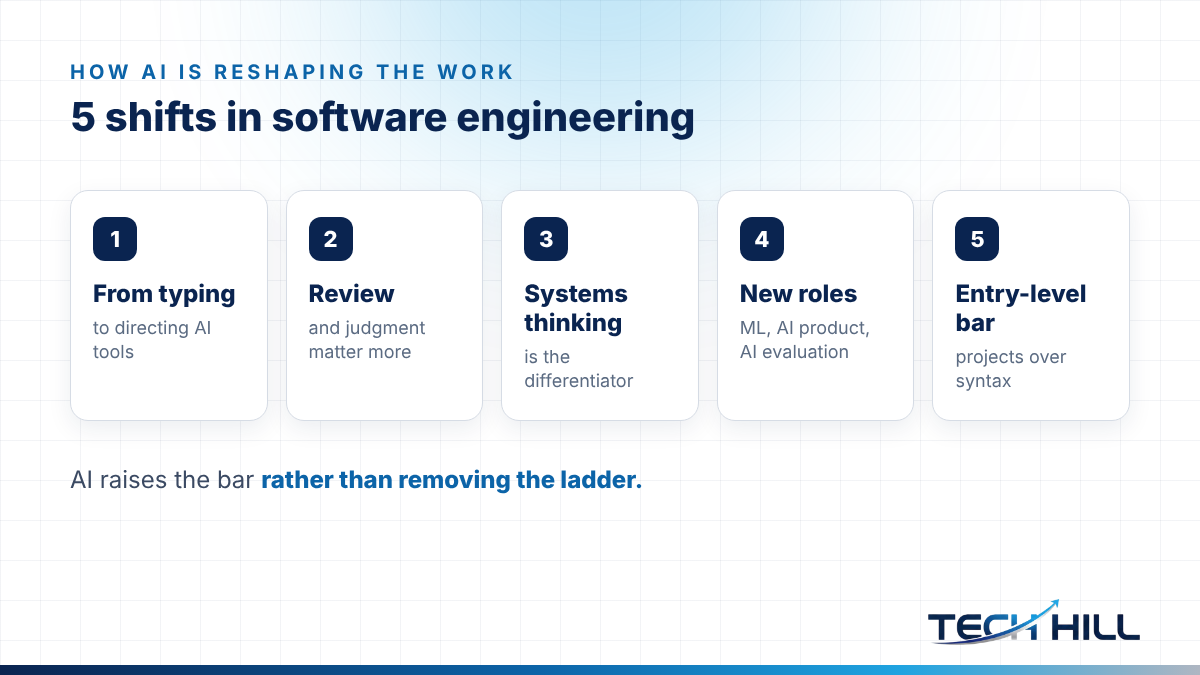
    Five ways AI is changing software engineering: from typing to directing AI tools, review and judgment, systems thinking, new roles, higher entry-level bar
    Five ways AI is changing the work of software engineers.
    • From typing to directing. AI coding assistants and agents can draft whole features from a description. Engineers spend more time writing clear specifications, breaking problems down and reviewing output.
    • Review and judgment matter more. AI-generated code can look right and still be wrong. Spotting subtle bugs, security holes and poor design choices is now a core skill.
    • Systems thinking is the differentiator. Knowing how databases, networks, cloud services and APIs fit together is what turns AI output into a working product.
    • New roles are emerging. Machine learning engineering, AI product development, data infrastructure and AI evaluation and safety barely existed as job titles a decade ago.
    • Entry-level work is changing. Simple tasks once given to juniors are increasingly automated, so new graduates are expected to show real projects and problem-solving ability, not just syntax.

    The takeaway: AI raises the bar rather than removing the ladder. People who understand fundamentals and can work with AI are more productive than ever.

    Computer Science vs. Software Engineering: what is the real difference?

    The two degrees overlap heavily, especially in the first two years. Both cover programming, data structures, algorithms and discrete math. The difference is mostly emphasis: Computer Science asks how computing works and what is possible, while Software Engineering asks how to build reliable software that people can depend on.
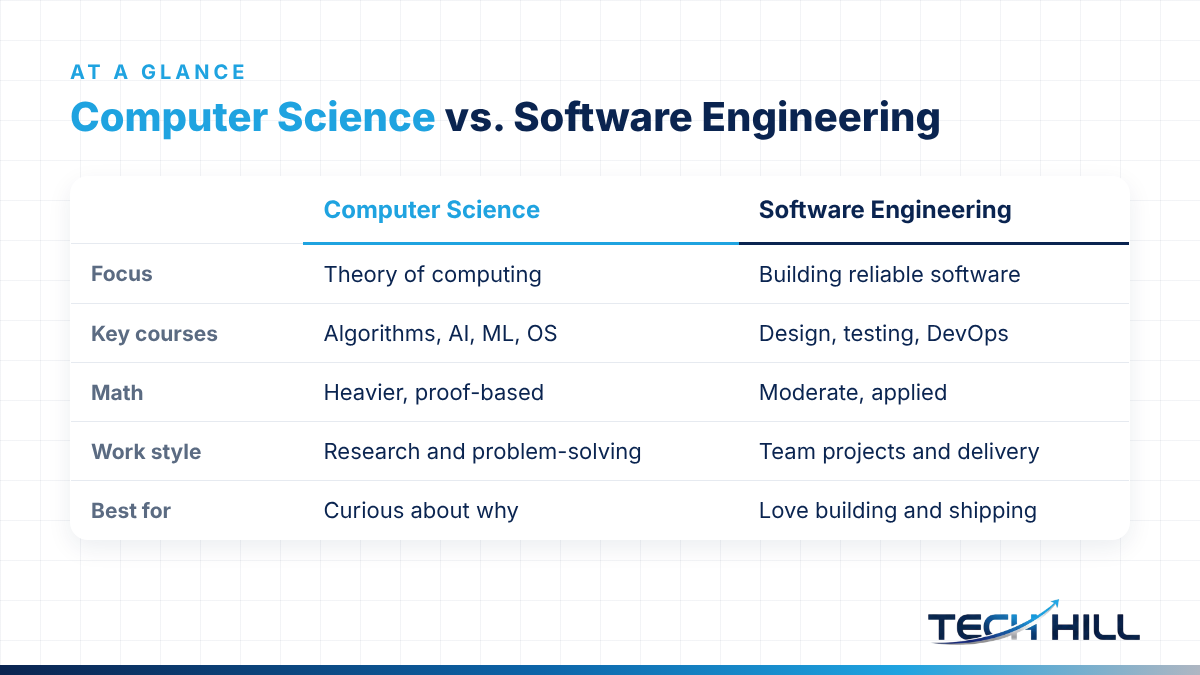
    Comparison table of Computer Science vs Software Engineering by focus, key courses, math, work style and who each degree is best for
    Computer Science vs. Software Engineering at a glance.
    Computer ScienceSoftware Engineering
    Core focusTheory and foundations of computingProcess and practice of building software
    Typical coursesAlgorithms, theory of computation, AI, machine learning, compilers, operating systemsRequirements, software design and architecture, testing, project management, DevOps
    Math loadHeavier (linear algebra, probability, discrete math, proofs)Moderate, more applied
    Style of workResearch, problem-solving, building new techniquesTeam projects, delivering products, quality and maintenance
    Common careersAI/ML engineer, researcher, data scientist, systems engineer, software developerSoftware engineer, QA/test engineer, DevOps engineer, solutions architect, project lead
    Best forStudents curious about why things workStudents who love building and shipping things
    Computer Science vs. Software Engineering at a glance

    In practice, employers hire graduates from both programs for the same software developer roles. What separates candidates is far more often their skills, projects and internships than the exact name on the degree.

    Why the choice feels harder in the AI era

    New students are not confused because they lack information. They are confused because they have too much of it, and much of it conflicts. Social media is full of posts saying “coding is dead” right next to posts about record demand for AI talent.

    • “Will AI take the jobs I am training for?” Students fear spending four years on skills that may be automated.
    • “Which degree is more future-proof?” Some assume CS is safer because AI research lives there; others think SE is safer because companies always need people to ship products.
    • “The names sound the same.” Universities define these programs differently, so a Software Engineering degree at one school may look like Computer Science at another.
    • “What if I pick wrong?” Students worry the choice locks them in for life.

    The good news: most of these fears are bigger than the reality. The two fields share a foundation, switching between them early is usually possible, and both feed directly into the AI economy.

    How to choose: practical advice for students

    There is no universally “better” degree, only a better fit for you. These steps make the decision clearer:
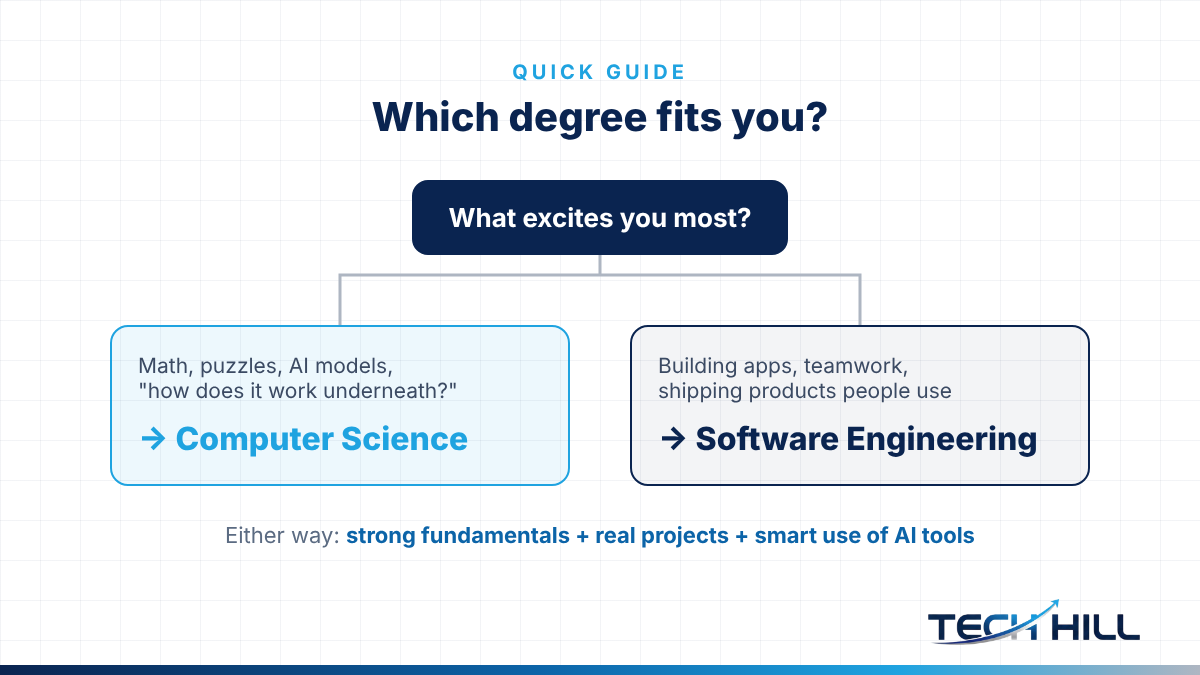
    Decision guide: choose Computer Science if you love math, puzzles and AI models; choose Software Engineering if you love building apps and teamwork
    A quick way to decide which degree fits you.
    1. Read the actual curriculum. Compare course lists at the universities you are considering. The program content matters more than its title.
    2. Be honest about what excites you. If puzzles, math and “how does this work underneath?” questions energize you, lean toward Computer Science. If you love building apps, working in teams and seeing people use what you made, lean toward Software Engineering.
    3. Follow the AI interest if you have one. Students aiming for machine learning research or building AI models often benefit from the deeper math and theory in Computer Science.
    4. Talk to people a few years ahead. Seniors, recent graduates and working engineers can tell you what the programs and jobs are really like.
    5. Build things early, whatever you choose. Personal projects, open-source contributions, hackathons and internships carry real weight with employers.
    6. Learn to use AI tools well. Treat AI assistants as a study partner and productivity tool, but make sure you understand every line you submit.
    7. Keep the fundamentals strong. Algorithms, data structures, system design and clear communication stay valuable however the tools change.

    Frequently asked questions

    Is Computer Science or Software Engineering better in the age of AI?

    Neither is universally better. Computer Science suits students who want to work on AI models, algorithms and research because it goes deeper into math and theory. Software Engineering suits students who want to build and maintain real products in teams. Both lead to strong careers, and employers often hire graduates of either for the same developer roles.

    Will AI replace software engineers?

    AI is not replacing software engineers, but it is changing the job. AI tools now write much routine code, so engineers spend more time on design, problem definition, reviewing AI output, security and system architecture. Engineers who understand fundamentals and use AI well are more productive and in demand.

    What is the main difference between Computer Science and Software Engineering?

    Computer Science focuses on the theory of computing: algorithms, computation, AI and how computers work. Software Engineering focuses on the process of building reliable software: requirements, design, testing, project management and maintenance. The first two years of both degrees often overlap heavily.

    Which degree is better for a career in artificial intelligence?

    Computer Science is usually the stronger choice for AI research and machine learning engineering because it includes more linear algebra, probability, statistics and machine learning courses. Software Engineering graduates also work in AI, especially in building, deploying and maintaining AI-powered products.

    Can I switch from Software Engineering to Computer Science later?

    In many universities, yes, especially in the first year or two, because the programs share core courses. Rules vary by institution, so check the transfer policy early. After graduation, skills and projects matter more than the degree title, so moving between CS and SE roles is common.

    What skills should students learn to stay relevant as AI grows?

    Focus on fundamentals such as data structures, algorithms and system design, plus problem decomposition, code review, security basics, cloud and data skills, and clear communication. Learn to use AI coding tools effectively while making sure you understand every line of code you submit.

    Conclusion

    AI is changing software engineering faster than any shift in recent memory, but it is not making technical careers obsolete. It rewards people who think clearly, understand systems deeply and adapt quickly.

    For students stuck between Computer Science and Software Engineering, the most important thing to know is this: both are strong paths into the same exciting industry. Choose the one that matches how you like to think and learn, then invest in curiosity, real projects and continuous learning. The degree opens the door; what you build after that carries you forward.

  • AI, Software and Development in Ethiopia: 20 Common Questions Answered (2026)

    AI, Software and Development in Ethiopia: 20 Common Questions Answered (2026)

    Last updated: 19 November 2026

    Every week, business owners, founders, students and developers ask us the same questions about technology in Ethiopia. Is ChatGPT available here? What does the national AI policy say? How much does a website cost? Which laws apply to online businesses? This guide answers the 20 most common questions in plain language, with links to the official and trusted sources behind each answer.

    Key takeaways

    • AI is officially supported: Ethiopia has a National AI Policy (June 2024) coordinated by the Ethiopian Artificial Intelligence Institute, and ChatGPT is available in the country.
    • Talent is growing: Ethiopia has a young, fast-growing developer workforce working for local firms and international clients.
    • Mobile money powers online payments: websites in Ethiopia typically accept telebirr, CBE Birr, M-PESA and local gateways like Chapa and SantimPay.
    • Data protection is now law: Proclamation No. 1321/2024 applies to any organization handling personal data in Ethiopia.
    • Startups have a legal framework: the Startup Proclamation No. 1396/2025 introduces designation, incentives and a startup fund.

    Contents

    Artificial intelligence (AI) in Ethiopia

    Is ChatGPT available in Ethiopia?

    Yes. Ethiopia is on OpenAI’s official list of supported countries, so people in Ethiopia can sign up for ChatGPT and the OpenAI API without a VPN. Google’s AI chatbot (now Gemini) has also been available in Ethiopia since 2023.

    This is a big change from early 2023, when ChatGPT was not accessible in Ethiopia and many users relied on VPNs or locally built tools based on older models. Today, Ethiopian businesses can use these AI tools directly and build them into websites and apps through their APIs.

    Does Ethiopia have a national AI policy?

    Yes. Ethiopia’s National Artificial Intelligence Policy was approved by the Council of Ministers on 27 June 2024. It guides how public and private organizations develop and use AI, sets risk-management expectations for critical sectors, and names the Ethiopian Artificial Intelligence Institute (EAII) as the coordinating body. Its motto is “AI for All.”

    The policy was developed through a multi-stakeholder process led by the EAII and the Ministry of Innovation and Technology. It encourages collaboration between government, universities, the private sector, the Ethiopian diaspora and international partners.

    What is the Ethiopian Artificial Intelligence Institute (EAII)?

    The EAII is the federal agency responsible for AI in Ethiopia. Established in 2020 and accountable to the Prime Minister, it carries out AI research and training, helps shape national AI policy, and can certify AI products and services for use in the country. Its 2025/26 budget was 1.13 billion Birr, a 42% increase on the previous year.

    In February 2026, the EAII opened an AI University Innovation Pod (UniPod) with UNDP and Addis Ababa University, a hub for developing AI solutions with national and pan-African impact.

    How are Ethiopian businesses and institutions using AI?

    The most common uses are customer-service chatbots, document and data processing, fraud and risk detection, and tools for agriculture, education and finance. For example, in January 2026 the EAII and Ethiopia’s Financial Intelligence Service agreed to build an AI system to help detect money laundering and illicit financial flows.

    For small and medium businesses, practical starting points include:

    • An Amharic and English chatbot on your website or Telegram channel that answers common questions
    • Automatically sorting and replying to customer messages and emails
    • Summarizing reports, contracts and meeting notes
    • Drafting marketing content and product descriptions
    • Smarter search and recommendations on e-commerce websites

    Can AI tools understand Amharic and other Ethiopian languages?

    Increasingly, yes, but quality still lags behind English. Leading AI models can read and write Amharic well enough for many everyday tasks, and the EAII is working on natural language processing for Ethiopian languages. For customer-facing tools in Amharic, Afaan Oromo or Tigrinya, always test with native speakers before launch.

    What are the biggest challenges for AI in Ethiopia?

    The two most cited challenges are a shortage of high-quality local data and a lack of skilled AI professionals. The EAII’s Director General has described data as the “fuel” for AI systems. Internet access, affordability and computing infrastructure also limit how quickly AI spreads beyond major cities.

    Software development and tech careers

    Web developer working on a laptop
    Photo: Kojo Kwarteng on Unsplash

    How much do software developers earn in Ethiopia?

    Salaries vary widely by experience and employer. WageIndicator puts most software developers between about ETB 10,600 and ETB 34,500 per month, while higher-paying private and outsourcing firms report roughly ETB 30,000–70,000 for juniors, ETB 80,000–150,000 for mid-level and ETB 150,000–350,000 for senior developers. Developers working remotely for foreign companies often earn more.

    Pay depends heavily on the employer (government, local private company, international NGO, outsourcing firm or remote foreign employer), specialization and English communication skills.

    Is Ethiopia a good place to outsource software development?

    For many companies, yes. Ethiopia offers a large, young pool of tech graduates, competitive costs, and a time zone (UTC+3) that overlaps well with Europe, the Middle East and East Africa. The main trade-offs are uneven internet speeds outside major cities and foreign-currency payment friction, so choose a partner with reliable infrastructure and clear contracts.

    How do Ethiopian developers and freelancers get paid by foreign clients?

    Usually through international bank transfers to an Ethiopian bank, payouts from freelance platforms, or licensed money-transfer and payment services. PayPal is not a full option: accounts registered in Ethiopia can send payments but cannot receive or withdraw funds. Be wary of any “client” who insists on paying through gift cards, crypto or a personal mobile-money line.

    Which programming skills are most in demand in Ethiopia?

    From what we see in the market, the most requested skills are JavaScript and TypeScript (React, Next.js, Node.js), PHP and WordPress, Python (Django, FastAPI, data and AI work), Flutter for mobile apps, and Java or .NET for banks and enterprise systems. Payment integration, cloud hosting and AI API skills are increasingly valuable.

    Building websites and apps in Ethiopia

    How much does it cost to build a website in Ethiopia?

    It depends on scope. A simple informational website for a small business costs far less than an e-commerce store or a custom web application with user accounts, payments and multiple languages. When comparing quotes, check what is included: hosting, domain, mobile-friendly design, SEO setup, training, security updates and ongoing support, and ask for a fixed-scope written quote.

    For a deeper look at what a good Ethiopian website needs, read our guide: Website Development in Ethiopia: A Complete Guide for Businesses in 2026.

    How long does it take to build a website or app?

    As a rough guide, a simple business website takes 2–4 weeks, a larger company website 4–8 weeks, and an e-commerce site or mobile app 2–6 months. The biggest factor is usually how quickly content, photos and feedback are provided, not the coding itself.

    How can my website accept online payments in Ethiopia?

    Most Ethiopian websites accept payments through mobile money and local payment gateways such as telebirr, CBE Birr, M-PESA, Chapa and SantimPay. For international card payments, some Ethiopian banks offer card payment gateways. Online sellers are expected to work with payment operators licensed by the National Bank of Ethiopia.

    If you sell to the diaspora or international customers, plan for both local mobile money and card payments from the start, so checkout works for everyone.

    Should I build a website or a mobile app first?

    For most businesses, start with a fast, mobile-friendly website. It works on every phone without a download, can be found on Google, and costs less to build and maintain. Build a native app later if customers will use it often, for example for ordering, banking, booking or loyalty programs.

    Should I host my website in Ethiopia or abroad?

    It depends on your audience and the data you collect. International hosting is often cheaper and offers more features, while local hosting can be faster for visitors in Ethiopia. If your site collects personal data from people in Ethiopia, the Personal Data Protection Proclamation restricts transferring personal data abroad, so get legal advice and consider local hosting for sensitive data.

    Tech laws and regulations in Ethiopia

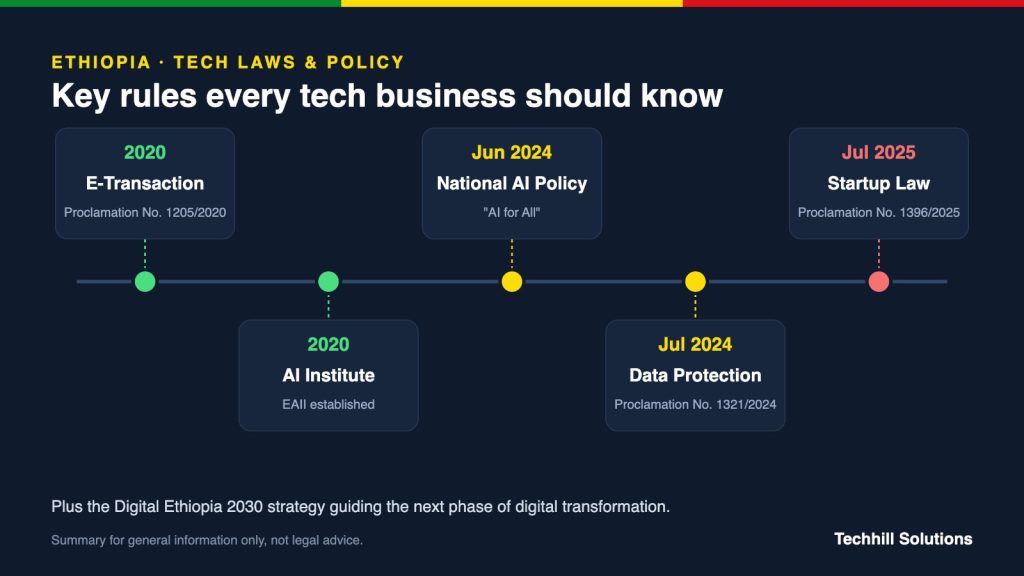
    Timeline of Ethiopian tech laws: E-Transaction Proclamation 1205/2020, EAII established 2020, National AI Policy June 2024, Data Protection Proclamation 1321/2024, Startup Proclamation 1396/2025
    Key Ethiopian tech laws and policies at a glance. General information, not legal advice.

    Does Ethiopia have a data protection law?

    Yes. The Personal Data Protection Proclamation No. 1321/2024 was adopted by Parliament on 4 April 2024 and entered into force on 24 July 2024. It applies to public and private organizations that handle personal data in Ethiopia and is enforced by the Ethiopian Communications Authority (ECA). Key duties include obtaining consent, keeping data secure, reporting breaches and limiting cross-border transfers.

    For a typical business website, practical first steps are:

    • Publish a clear privacy policy
    • Ask for consent on contact forms, sign-ups and non-essential cookies
    • Collect only the data you actually need
    • Use HTTPS, strong passwords and limited admin access
    • Know where your hosting provider stores your data

    This is general information, not legal advice. Speak to a qualified Ethiopian lawyer about your specific situation.

    What law governs e-commerce and online transactions in Ethiopia?

    The Electronic Transaction Proclamation No. 1205/2020 gives legal recognition to electronic transactions, records and signatures, and provides the legal basis for e-commerce and e-government services. It also includes provisions on consumer protection, digital payments and electronic receipts.

    Is there a startup law in Ethiopia?

    Yes. The Startup Proclamation No. 1396/2025, approved by Parliament in July 2025, is Ethiopia’s first legal framework for startups. It creates a startup designation system, a Startup Ethiopia Council and a startup innovation fund, offers incentives, and exempts foreign startups from minimum investment capital requirements. Implementing rules are still being rolled out.

    Founders still report licensing delays across different levels of government, so allow extra time for registration and permits.

    Working with a development company

    How do I choose a reliable software or web development company in Ethiopia?

    Look at their portfolio of live projects, speak to past clients, and ask who will actually do the work. A good partner gives a clear written scope, timeline and price, explains hosting and maintenance costs, follows data protection rules, and registers your domain and code in your name.

    Who owns my website, domain and source code?

    You should. Make sure the contract states that the domain is registered in your business’s name and that you own the website content and source code once it is paid for. Also ask for admin access, hosting logins and backups, so you are never locked in to one developer.

    Final thoughts

    Ethiopia’s tech sector is moving fast. A national AI policy, new data protection and startup laws, widespread mobile money and a growing pool of developers are creating real opportunities for businesses that go digital now. The key is to build on the right foundation: a fast, mobile-friendly website, secure handling of customer data, and partners who understand the local market.

    Have a question we didn’t answer?

    At Techhill Solutions, we design and build websites, web applications and AI-powered tools for businesses and organizations in Ethiopia. If you are planning a project or have a question about technology in Ethiopia, get in touch with our team. We are happy to help.

    Sources