Last updated: 20 November 2026
Picture a student sitting with a university application, cursor hovering between two boxes: Computer Science and Software Engineering. Both promise a career in tech. Both teach programming. Both lead to jobs with “software” in the title. So which one is right?
A few years ago, that question was mostly about preference. Today it carries more weight. AI tools can now write, test and explain code, and many students quietly wonder whether either degree will still matter by the time they graduate. This guide explains how AI is changing software engineering, what each degree really offers, and how to choose with confidence.
Key takeaways
- AI is changing the job, not ending it: engineers now spend less time typing code and more time designing systems, guiding AI tools and reviewing their output.
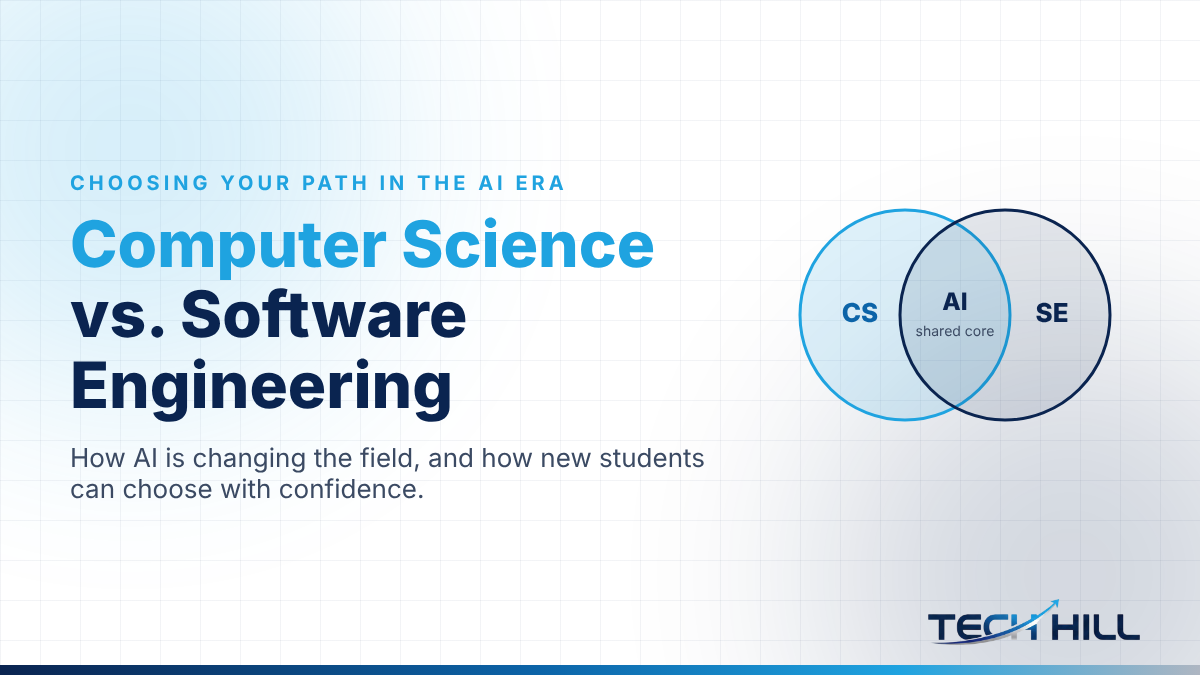
- CS and SE overlap heavily: both teach programming, data structures and algorithms. Computer Science leans toward theory and AI; Software Engineering leans toward building and maintaining real products.
- Choose by interest: pick Computer Science if you love math and “how does this work?” questions; pick Software Engineering if you love building things in teams.
- Skills beat titles: employers care most about fundamentals, real projects, internships and the ability to work well with AI tools.
How AI is reshaping software engineering
AI has not replaced software engineers, but it has changed what their day looks like. Writing routine code by hand is no longer the main event. The job is shifting toward deciding what to build, guiding AI tools, and checking that the result is correct, secure and maintainable.
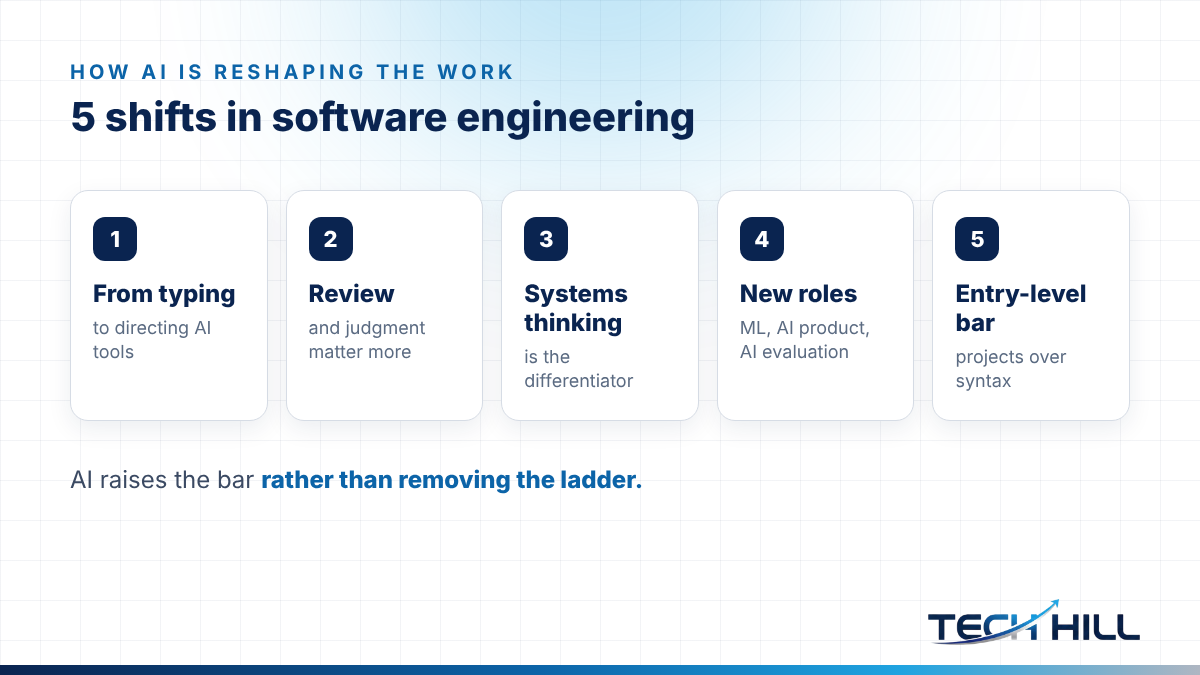
- From typing to directing. AI coding assistants and agents can draft whole features from a description. Engineers spend more time writing clear specifications, breaking problems down and reviewing output.
- Review and judgment matter more. AI-generated code can look right and still be wrong. Spotting subtle bugs, security holes and poor design choices is now a core skill.
- Systems thinking is the differentiator. Knowing how databases, networks, cloud services and APIs fit together is what turns AI output into a working product.
- New roles are emerging. Machine learning engineering, AI product development, data infrastructure and AI evaluation and safety barely existed as job titles a decade ago.
- Entry-level work is changing. Simple tasks once given to juniors are increasingly automated, so new graduates are expected to show real projects and problem-solving ability, not just syntax.
The takeaway: AI raises the bar rather than removing the ladder. People who understand fundamentals and can work with AI are more productive than ever.
Computer Science vs. Software Engineering: what is the real difference?
The two degrees overlap heavily, especially in the first two years. Both cover programming, data structures, algorithms and discrete math. The difference is mostly emphasis: Computer Science asks how computing works and what is possible, while Software Engineering asks how to build reliable software that people can depend on.
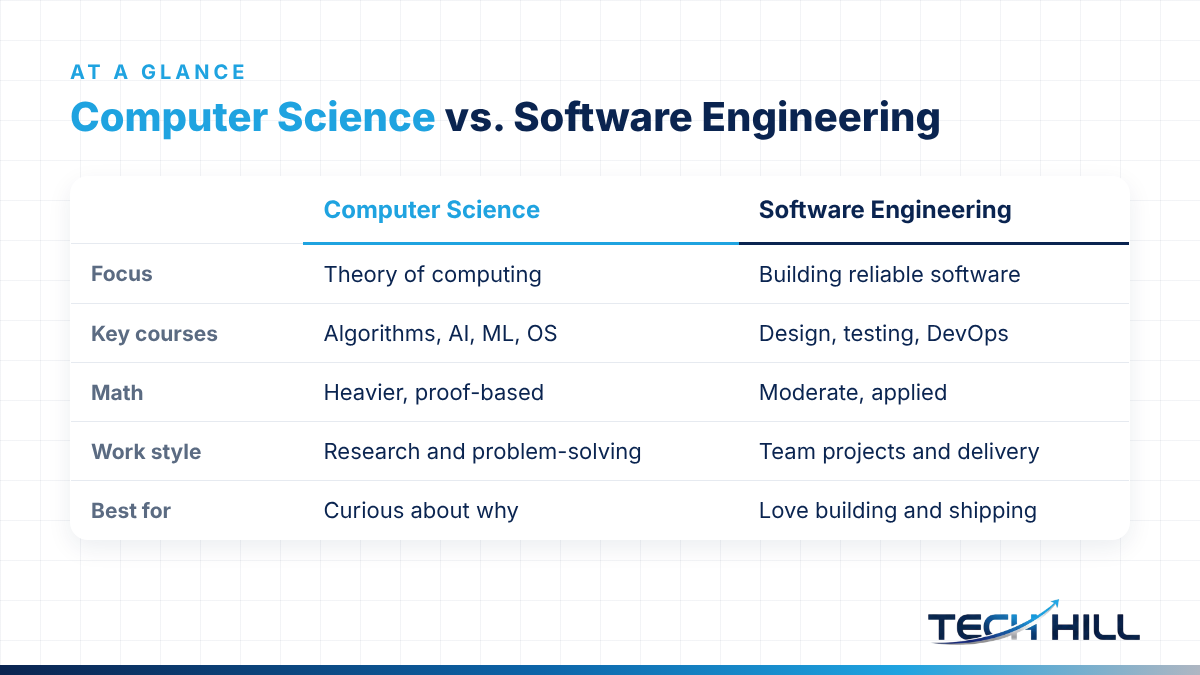
| Computer Science | Software Engineering | |
|---|---|---|
| Core focus | Theory and foundations of computing | Process and practice of building software |
| Typical courses | Algorithms, theory of computation, AI, machine learning, compilers, operating systems | Requirements, software design and architecture, testing, project management, DevOps |
| Math load | Heavier (linear algebra, probability, discrete math, proofs) | Moderate, more applied |
| Style of work | Research, problem-solving, building new techniques | Team projects, delivering products, quality and maintenance |
| Common careers | AI/ML engineer, researcher, data scientist, systems engineer, software developer | Software engineer, QA/test engineer, DevOps engineer, solutions architect, project lead |
| Best for | Students curious about why things work | Students who love building and shipping things |
In practice, employers hire graduates from both programs for the same software developer roles. What separates candidates is far more often their skills, projects and internships than the exact name on the degree.
Why the choice feels harder in the AI era
New students are not confused because they lack information. They are confused because they have too much of it, and much of it conflicts. Social media is full of posts saying “coding is dead” right next to posts about record demand for AI talent.
- “Will AI take the jobs I am training for?” Students fear spending four years on skills that may be automated.
- “Which degree is more future-proof?” Some assume CS is safer because AI research lives there; others think SE is safer because companies always need people to ship products.
- “The names sound the same.” Universities define these programs differently, so a Software Engineering degree at one school may look like Computer Science at another.
- “What if I pick wrong?” Students worry the choice locks them in for life.
The good news: most of these fears are bigger than the reality. The two fields share a foundation, switching between them early is usually possible, and both feed directly into the AI economy.
How to choose: practical advice for students
There is no universally “better” degree, only a better fit for you. These steps make the decision clearer:
- Read the actual curriculum. Compare course lists at the universities you are considering. The program content matters more than its title.
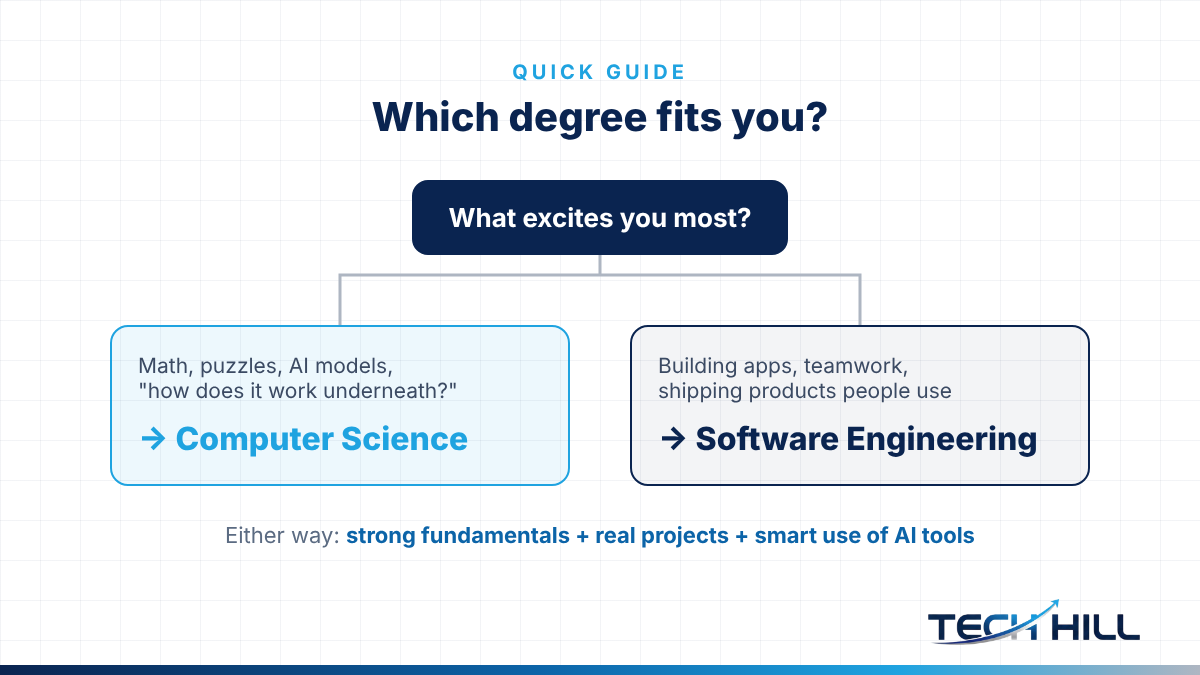
- Be honest about what excites you. If puzzles, math and “how does this work underneath?” questions energize you, lean toward Computer Science. If you love building apps, working in teams and seeing people use what you made, lean toward Software Engineering.
- Follow the AI interest if you have one. Students aiming for machine learning research or building AI models often benefit from the deeper math and theory in Computer Science.
- Talk to people a few years ahead. Seniors, recent graduates and working engineers can tell you what the programs and jobs are really like.
- Build things early, whatever you choose. Personal projects, open-source contributions, hackathons and internships carry real weight with employers.
- Learn to use AI tools well. Treat AI assistants as a study partner and productivity tool, but make sure you understand every line you submit.
- Keep the fundamentals strong. Algorithms, data structures, system design and clear communication stay valuable however the tools change.
Frequently asked questions
Is Computer Science or Software Engineering better in the age of AI?
Neither is universally better. Computer Science suits students who want to work on AI models, algorithms and research because it goes deeper into math and theory. Software Engineering suits students who want to build and maintain real products in teams. Both lead to strong careers, and employers often hire graduates of either for the same developer roles.
Will AI replace software engineers?
AI is not replacing software engineers, but it is changing the job. AI tools now write much routine code, so engineers spend more time on design, problem definition, reviewing AI output, security and system architecture. Engineers who understand fundamentals and use AI well are more productive and in demand.
What is the main difference between Computer Science and Software Engineering?
Computer Science focuses on the theory of computing: algorithms, computation, AI and how computers work. Software Engineering focuses on the process of building reliable software: requirements, design, testing, project management and maintenance. The first two years of both degrees often overlap heavily.
Which degree is better for a career in artificial intelligence?
Computer Science is usually the stronger choice for AI research and machine learning engineering because it includes more linear algebra, probability, statistics and machine learning courses. Software Engineering graduates also work in AI, especially in building, deploying and maintaining AI-powered products.
Can I switch from Software Engineering to Computer Science later?
In many universities, yes, especially in the first year or two, because the programs share core courses. Rules vary by institution, so check the transfer policy early. After graduation, skills and projects matter more than the degree title, so moving between CS and SE roles is common.
What skills should students learn to stay relevant as AI grows?
Focus on fundamentals such as data structures, algorithms and system design, plus problem decomposition, code review, security basics, cloud and data skills, and clear communication. Learn to use AI coding tools effectively while making sure you understand every line of code you submit.
Conclusion
AI is changing software engineering faster than any shift in recent memory, but it is not making technical careers obsolete. It rewards people who think clearly, understand systems deeply and adapt quickly.
For students stuck between Computer Science and Software Engineering, the most important thing to know is this: both are strong paths into the same exciting industry. Choose the one that matches how you like to think and learn, then invest in curiosity, real projects and continuous learning. The degree opens the door; what you build after that carries you forward.